 Snowkiting: what it is, where to do it and the equipment needed for this extreme
  The 7 best kites of 2025
  Surfskate: what it is, how it works and how to choose the ideal surfskate board
  How to choose a Wing Foil board: a guide for beginners and intermediate riders
  The 5 best all-round wing foil wings of 2025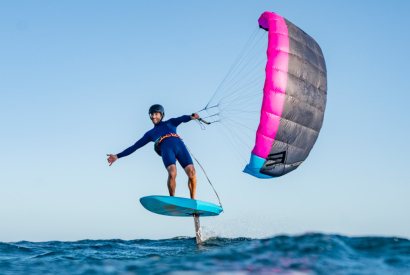
Parawing: the new frontier of Wing Foil between adrenaline and lightness
Are you looking for intense excitement and endless fun in the water to make the most of your summer days? Then get ready to discover Parawing, the new water sport trend that is revolutionising the world of Wing Foil.
Developed among the waves of Maui, in the enchanting islands of Hawaii (USA), Parawing is rapidly conquering thousands of watersports enthusiasts in every corner of the globe.
The secret of its success? Incredibly simple equipment to handle, starting with a small wing with no cumbersome cables, which can easily be stowed in the boot of the car or the locker of the boat. And then the adrenalin rush of flying on the surface of the water thanks to a board equipped with wing appendages, or foils, which, once in glide, allow you to rise out of the water and reduce any hydrodynamic friction.
Everything you need to start practising it is easily found:dedicated Parawing equipment is already available, designed to offer maximum lightness, control and freedom of movement.
This innovative discipline is perfect for those who love a challenge and want to try something new in 2025.

Origins of Parawing: from space capsules to foils
The idea behind Parawing has its roots in the United States, specifically in the pioneering work of Francis Rogallo, a NASA (National Aeronautics and Space Administration) engineer who, together with his wife Gertrude, invented a special wing in the 1960s for the recovery of Mercury and Gemini space capsules that returned to Earth after missions. It was a completely new project, but despite its success, it was later shelved.
Recently, some watersports enthusiasts have reinterpreted that ingenious concept, creating an entirely new and highly addictive water discipline that is characterised by extremely synthetic and essential equipment and allows great freedom and fun in the water.
What is Parawing: the new evolution of Wing Foil
Parawing is to all intents and purposes a sailing sport that exploits the natural force of the wind. When sailing, propulsion is provided by a so-called “boxed” wing, similar to that of a parachute or kite trainer, which does not need to be inflated, and is therefore ready for use. This is held in place by a system of small bridles, making it light and easy to manoeuvre.
The rider controls the wing by means of a control bar, a boom similar to the one used in kiteboarding, which allows precise adjustment of the traction exerted by the wind and the direction of the wing itself. Among the models most prized for their manoeuvrability are the Ensis Roger and Flysurfer POW pocket wings, developed to provide exceptional performance for all ambitious foilers.

The wing's short lines make it easy to assemble and reduce the risk of creating tangles that are difficult to untangle. In addition, a harness can be used for the rider for greater comfort while sailing. Thanks to the power of the wind, the Parawing's wing makes it possible to speed through the water on a surfboard equipped with hydrofoils, special wing appendages that allow you to rise out of the water. The success of the Parawing is due to the fact that it is relatively easy to learn and allows rapid progress, opening the door to water surface navigation to everyone.
How Parawing works: wing, foil and total freedom
One of the great advantages of Parawing is that it allows you to have fun in very little wind. The effective propulsion of the wing and the foil navigation that reduces friction in the water make it possible to glide even in light breezes. If the wind picks up, no problem: the small-sized wing allows you to safely handle even stronger conditions.
Models such as the Duotone Stash and the Ozone Pocket Rocket stand out for their compactness and quick transitions, making them ideal for those seeking an immediate user experience.
In addition to being very easy to learn the handling and directional changes, the Parawing is designed to catch the wind very quickly, allowing a dynamic and immediate waterstart even in moderate wind conditions. Finally, the equipment is absolutely versatile and compact: the wing folds in an instant, is lightweight and stows easily in a bag, making it easy to transport and store.

Difference between Wing Foil and Parawing: more lightness, less effort
The main difference between Wing Foil and Parawing concerns the wing. In the classic Wing Foil, an inflatable wing is used, whereas in Parawing the wing is rigid and boxed. This results in:
- greater lightness and practicality;
- better response in low wind;
- quicker assembly and disassembly;
- less bulk and ease of transport.
Parawing is therefore ideal for those looking for a modern, adrenaline-filled yet accessible discipline. To discover all the differences and find the right equipment, visit Kiteworldshop.com.
Wing Foil and Parawing: 2025 trends to watch
Wing Foil 2025 trends speak for themselves: Parawing is set to become one of the most popular new water sports. Videos, tutorials and testimonials from those who have tried it and fallen in love with it are increasing on social networks and beaches around the world.
The equipment market is also adapting, with new box wing models, compatible boards and accessories designed for this fast-growing discipline. These include the North Ranger, extremely balanced for performance and control, and the Naish Morph, perfect for exploring new foiling possibilities.

Photo Credit
Photo 1: ENSIS
Photo 2: FLYSURFER
Photo 3: OZONE
Photo 4: DUOTONE
Photo 5: OZONE


